
Knee pain ranks among the most frequently mismanaged musculoskeletal complaints in primary care. Many patients spend months, sometimes years cycling through generic advice before receiving a clear, actionable diagnosis.
In Bristol, Mr Sven Putnis a Trauma and Orthopaedic Consultant and Specialist Knee Surgeon has clinics at:
– Spire Bristol Hospital, The Glen, Redland Hill
– Nuffield Health Bristol Hospital, 3 Clifton Hill, Clifton
He applies a structured, evidence-led approach to identifying and managing knee osteoarthritis (OA) as early as possible, before irreversible damage sets in. This article covers the key diagnostic steps, imaging strategies, and the full range of treatment options available today, drawing directly from his clinical methodology, referral pathway expertise, and the latest peer-reviewed evidence.
Clinical Assessment Reading the Right Signals
Symptoms That Deserve Proper Attention
Progressive, localised knee pain persisting beyond a few weeks particularly in a previously active person is a meaningful signal warranting prompt assessment. Mechanical symptoms such as grinding, crunching, catching, or locking suggest structural involvement beyond soft tissue irritation. Frequent joint swelling is important to identify as it implies that there is an inflammatory component to the joint condition. Episodes of instability, giving way, reduced range of movement, or visible changes in knee shape all add diagnostic weight to a mechanical cause. History-taking should methodically cover the pain location, aggravating activities, and swelling frequency details that distinguish early knee OA from other pathologies and prevent unnecessary delays in appropriate referral.
What a Focused Examination Reveals
A reliable examination goes beyond testing range of motion. Coronal alignment varus or valgus deformity and fixed flexion directly influences load distribution and informs both non-surgical and surgical planning. Gait symmetry and muscle bulk asymmetry reflect long-standing compensatory patterns worth documenting. The knee itself requires assessment for effusion, joint-line or patellofemoral tenderness, and instability. McMurray’s test adds value when meniscal involvement is suspected. Hip and lumbar spine pathology must always be excluded, as referred pain in this region remains one of the most common diagnostic pitfalls encountered in primary care knee assessment.
Getting the Imaging Right From the Outset
Standing X-Rays — The Essential Starting Point
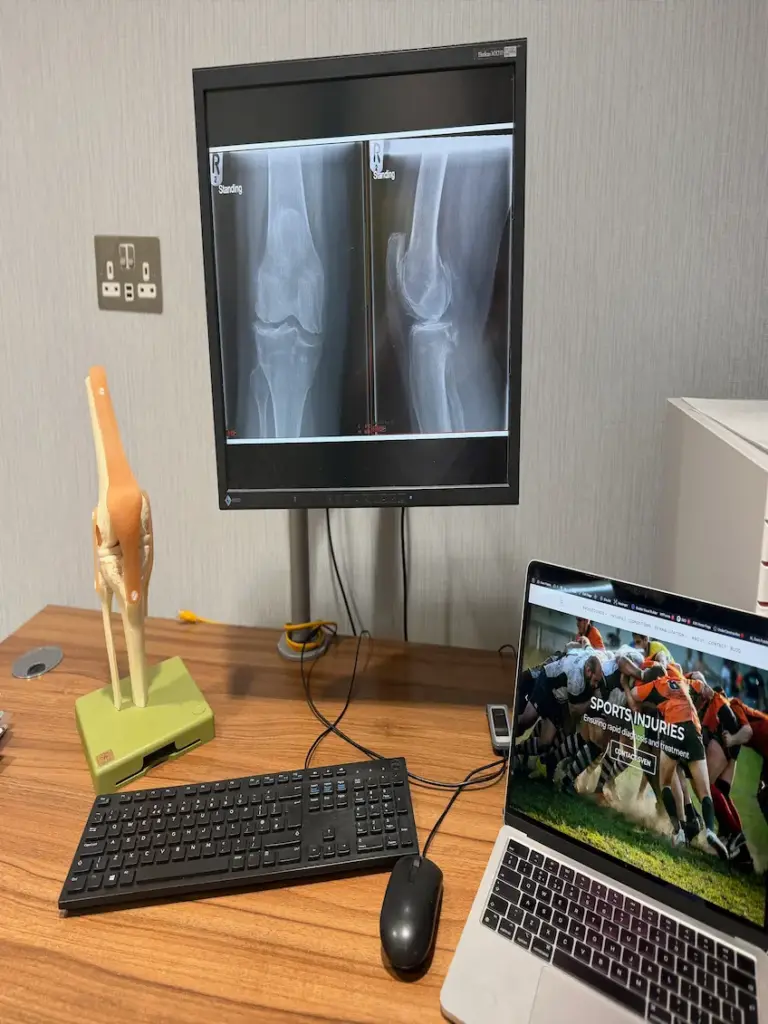
Correct imaging underpins every sound management decision. A standing, weight-bearing AP/PA and lateral x-ray should accompany all knee referrals in patients aged 55 and over and in younger patients whenever OA is clinically suspected. The skyline patellofemoral view provides detail when anterior symptoms or kneecap involvement is present. Long-leg standing films taken from the hips down to the ankles provide essential information. They are weightb-bearing and functional, they can accurately measure coronal malalignment to quantify deformity and directly inform knee bracing, realignment planning or suitability for a partial knee replacement. They also screen the hip joints and pelvis to ensure that the pain is not referred from higher up.
Ordering the correct x-ray views prevents the delays caused by incomplete imaging and ensures a complete diagnostic picture from the very first appointment.
Early MRI — The Scan That Can Change Everything
A normal x-ray does not rule out significant structural pathology. Cartilage damage, meniscal tears, and ligament injury are invisible on plain film but clearly visible on MRI. Consider a patient in their early fifties previously active, presenting with a year of worsening knee pain. Their x-ray shows well-preserved joint spaces. Their MRI reveals a complex medial meniscal tear involving the posterior root, early to moderate chondral loss in the medial compartment, and a low-grade MCL sprain. An arthroscopic meniscal root repair can be performed as a day-case procedure and completely change the trajectory for the knee. An early MRI transforms the entire management approach making it the single most important investigation for patients with persistent symptoms and a ‘normal’ knee x-ray.
Non-Surgical Management — The Evidence-Based Treatment Ladder
Physiotherapy as the Cornerstone
Regardless of what adjunct treatments are introduced, physiotherapy remains the foundation of non-surgical knee OA care. Structured rehabilitation addresses muscle weakness, altered movement patterns, and the abnormal joint loading that accelerates OA progression. Other treatments achieve the most when they support physiotherapy rather than replace it. Every knee operation should come with physiotherapy included, often benefitting from pre-operative as well as post-operative care.
A steroid injection delivered without a rehabilitation plan offers only a temporary window. The idea is to break through pain to facilitate a push for engagement with physiotherapy; it should be arranged before or immediately alongside any injection-based intervention.
Choosing the Right Knee Injection
Currently, 3 different injection options are offered for knee OA in the clinic, each with a distinct mechanism:
Corticosteroid injections – reduce joint inflammation rapidly, with relief typically lasting two to ten weeks. Per NICE guidance, they are appropriate when physiotherapy and analgesia have not achieved sufficient control. Their purpose is specific: to provide enough comfort for meaningful rehabilitation to begin. Ultrasound-guided perimeniscal steroid infiltration is growing in use for degenerative meniscal lesions, with evidence showing a low rate of surgical conversion.
Hyaluronic acid (HA) injections — specifically Durolane, a non-animal stabilised, high molecular weight formulation — replenish the lubricating properties of synovial fluid that degrade during OA. A six-year cohort study of 623 consecutive patients found sustained pain relief averaging 466 days post-treatment, with greater benefit in Grade 2 or 3 OA. HA is non-inferior to steroids short-term but offers superior durability.
Arthrosamid, an injectable polyacrylamide hydrogel (iPAAG), is a non-biodegradable implant that integrates into the synovial subintima and exerts an anti-inflammatory effect. A Keele University study demonstrated a 76% response rate at six months. Five-year data published in 2026 confirms durable symptom relief across age groups, BMI categories, and KL Grades 2 and 3. It performs best in inflamed, early-to-moderate OA — and a single injection can offer relief lasting several years.
Addressing Malalignment — Bracing and Osteotomy
Unloader Bracing for Medial Compartment Disease
Coronal malalignment places concentrated, repetitive stress on the affected knee compartment. In patients with predominantly medial wear and a correctable deformity, an unloader brace mechanically shifts load away from the damaged side. Evidence supports bracing as a cost-effective, non-surgical option that improves function, reduces pain, and can delay the need for surgery. It can be effectively used alongside a knee injection so the mechanical issues are addressed at the same time as the joint inflammation. This is important as long-term compliance with braces can vary. Clinical adoption of bracing continues to expand as its evidence base grows. Combining bracing with physiotherapy can correct muscle balance and conditioning.
Periarticular Osteotomy — Preserving the Joint
For younger, active patients with significant coronal deformity and unicompartmental OA, periarticular osteotomy offers a joint-preserving surgical alternative. By correcting the mechanical axis of the leg, it redistributes load away from the damaged compartment onto healthier cartilage. High tibial osteotomy (HTO) is the most commonly performed variant. A 2024 systematic review confirms high survivorship and favourable outcomes even in radiologically advanced medial OA. Rehabilitation is longer than joint replacement, but preserving the native joint delivers enormous long-term value for patients with decades of active life ahead.
Surgical Options — Partial and Total Knee Replacement
Unicompartmental Knee Arthroplasty (UKA)
For isolated medial, lateral, or patellofemoral compartment OA that has progressed beyond conservative management, UKA resurfaces only the damaged compartment whilst preserving the rest of the joint. The landmark TOPKAT Lancet RCT concluded that partial knee replacement should be the preferred first-line surgical option for late-stage isolated medial OA. UKA delivers superior Oxford Knee Score results in the early post-operative period, with patients consistently reporting a more natural-feeling knee. Its revision rate sits marginally higher than total replacement — 7% versus 5% at 15 years — though lifetime revision risk decreases substantially with increasing age at the time of surgery.
Total Knee Replacement and Who Qualifies
Total knee replacement is appropriate for multi-compartmental OA or patients unsuitable for partial replacement. NICE is explicit: BMI, age, sex, smoking status, and comorbidities must not serve as barriers to surgical referral. Evidence confirms that overweight and obese patients achieve comparable quality-of-life improvements following joint replacement, without increased mortality risk. Referral decisions must be based on clinical assessment after exhausting appropriate conservative options — not on demographic exclusion criteria.
Conclusion
Knee osteoarthritis does not have to mean inevitable decline. With early imaging, accurate structural diagnosis, and a carefully staged treatment plan, most patients coming to see Sven Putnis in Bristol can reclaim meaningful function, reduce their pain, and delay or avoid major surgery altogether. The pathway outlined here reflects current NICE guidance and the latest peer-reviewed clinical evidence, delivered through the hands of an experienced specialist.
For expert knee assessment in Bristol, contact Mr Sven Putnis at Spire Bristol Hospital, The Glen, Redland Hill, Bristol BS6 6UT, or Nuffield Health Bristol Hospital, 3 Clifton Hill, Clifton, Bristol BS8 1BN. svenkneeclinic.co.uk | jess@svenkneeclinic.co.uk
Frequently Asked Questions
What causes knee pMy x-ray looks normal but my knee pain keeps worsening — should I request an MRI?ain?
A normal x-ray does not exclude significant structural pathology. Cartilage damage, meniscal tears, and ligament injuries are invisible on plain film but clearly visible on MRI. Persistent, worsening knee pain despite a reassuring x-ray is a clear indication for MRI, particularly in active, sporty patients. Identifying structural changes early through timely MRI creates more treatment options and prevents the slow, damaging progression to joint failure that occurs when pathology goes undetected and unmanaged.
How is a hyaluronic acid injection different from a steroid injection?
Steroid injections reduce inflammation rapidly, typically lasting two to ten weeks — their purpose is to enable active physiotherapy engagement. Hyaluronic acid restores the lubricating properties of synovial fluid, building effect gradually and lasting up to 12 months in many patients. They are not interchangeable. The right choice depends on the individual’s clinical presentation, the degree of joint inflammation, and what the treatment is intended to achieve within the overall management plan.
Is Arthrosamid suitable for every knee OA patient?
Arthrosamid is best suited to patients with inflamed, early-to-moderate OA who have not responded adequately to physiotherapy and conventional injections. It is not appropriate for those with primarily mechanical issues — such as malalignment, loose bodies, or advanced joint failure. Suitability is always assessed individually during a specialist consultation, where imaging and clinical findings are reviewed to determine the most appropriate treatment pathway.
Can I have a partial rather than a full knee replacement?
In many cases, yes — provided the OA is confined to one compartment and the remaining joint remains healthy. The TOPKAT trial supports partial knee replacement as the preferred first-line surgical choice for isolated medial OA. A partial replacement preserves more native tissue, typically results in faster recovery, and tends to feel more natural long term. Detailed imaging and specialist assessment determine technical suitability on a case-by-case basis. Sven Putnis now performs as many partial knee replacements as total knee replacement with a very high success rate.
I was told I cannot have a knee replacement because of my weight — is that correct?
No. NICE guidelines explicitly state that BMI must not be used as a barrier to joint replacement referral. Patients who are overweight or obese achieve meaningful improvements in function and quality of life following surgery, without increased mortality risk. If referral has been declined on the basis of weight alone, seeking a specialist opinion directly. Sven Putnis has developed pathways and surgical techniques to reduce the risk for knee surgery in patients with severe and complex obesity (BMI 40-50) and seeking his opinion is highly recommended.
